
Joe is a strategic visionary who transformed our business operations, simplifying and improving processes while enabling us to focus on growth. His guidance helped us reduce founder dependency and paved the way for long-term success.

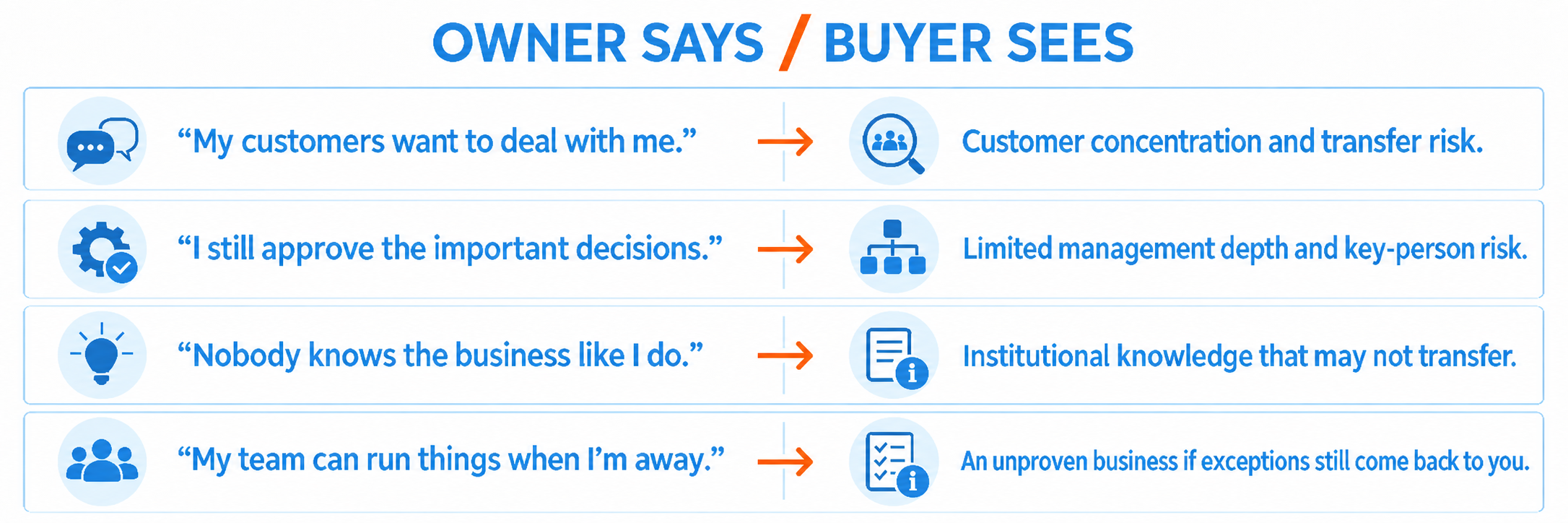
What you see as normal owner involvement may look very different to a Buyer: key-person risk, limited management depth, growth constraints and transition risk.
The real risk is not that you’re involved. It’s that the business has been built around your decisions, knowledge and relationships.


Owners of $3M–$20M revenue businesses often accept a certain amount of dependence as normal. They know the customers, make the tough calls and step in when something goes wrong. But over time, that dependence can constrain growth—and eventually become risk a buyer is being asked to inherit.
The problem isn’t knowing you’re too involved. It’s understanding why the business keeps pulling you back in.
Your decisions, relationships and knowledge have shaped how the company operates for years. From inside the business, it’s difficult to see which dependencies are necessary—and which simply became normal.
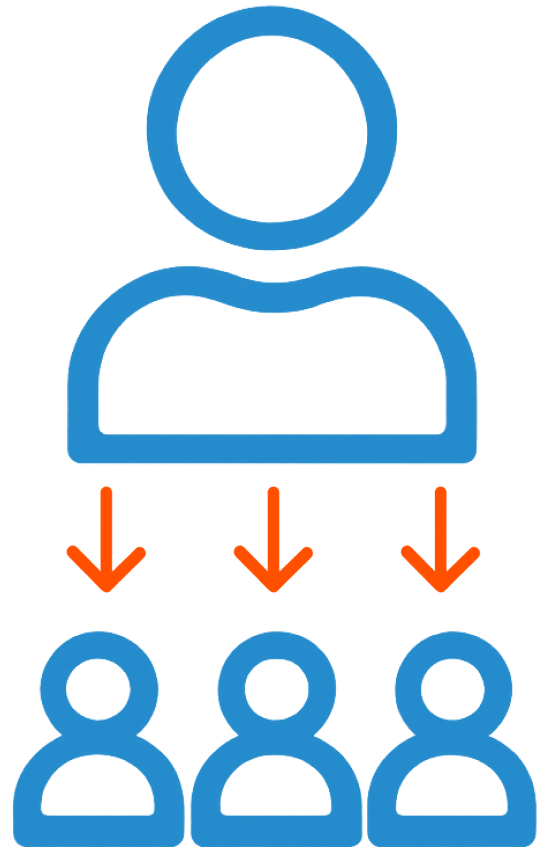
A manager can take on more work, but if customers, employees and important decisions still come back to you, the dependency hasn’t really moved. Responsibility without authority just adds another layer.
You see trusted relationships, experienced judgment and hands-on leadership. A buyer may see key-person risk, limited management depth and a business that still needs you after closing.

I’ve spent my career as an operator, not a career consultant. I’ve scaled businesses to $100M, worked through growth ceilings and turnarounds, and lived through two exits to private equity and strategic buyers.
Along the way, I learned that the same owner involvement that helps build a good business can eventually become what limits its growth and makes it harder to transfer. I’ve experienced the challenge of stepping back, building management capability and creating a company that can perform without everything coming back to the owner.
Today, I bring that operator experience together with my work as a Certified Exit Planning Advisor to help business owners see their company differently: how it is wired around them today, how that dependence limits growth, and how a future buyer is likely to view the risks they leave behind.
Understand what could stand in the way of your exit
Make the business stronger, less dependent and more attractive
Turn improvements into buyer-ready evidence
The symptoms may look different, but the underlying problem is often the same: the business still depends too much on the owner.
You’ve built a good business, hired capable people and tried to delegate—but growth keeps creating more work, decisions and complexity for you.
Typical signs:
Bottom Line: The growth ceiling may not be the market. It may be how the business is wired around you.
The business performs well, but too much of its success still depends on your decisions, relationships and knowledge—and there is now a deadline to change that.
Typical signs:
Bottom Line: A few years before exit, Owner Dependence can be fixed. During due diligence, it gets priced into the deal.
Joe is a strategic visionary who transformed our business operations, simplifying and improving processes while enabling us to focus on growth. His guidance helped us reduce founder dependency and paved the way for long-term success.

CEO, Naryant Data Management
Joe’s program was transformative. He uncovered blind spots, optimized processes, and structured my business for a future exit. His friendly, insightful, and practical approach has positioned my company for sustained growth and success.

CEO, Commercial Luxury Appliance Installation Company & CEO Global Network Member
Joe helped us simplify processes, focus on growth, and align our team around shared goals. His strategic advice and actionable insights have been critical to our business transformation.

CEO, Software Development Company
Joe helped me clarify my goals and prioritize what truly matters. His ability to cut through the noise and focus on actionable steps was a game-changer for my business. I now feel confident, making real progress toward my objectives.

CEO, Freight Management Scale-Up
The optimal time to address Owner Dependence is 3–5 years before your desired exit. Unsolicited offers reduce leverage if you're not ready.
You still have time to transfer responsibilities, strengthen management, improve earnings and prove the changes are sustainable.
Get outside your own view of the business.
Identify where decisions, knowledge, relationships and financial performance create growth constraints or buyer risk.
Use the runway to build a stronger, more transferable business.
The goal is greater choice around when you exit, who you sell to, how long you stay—and the terms you’re prepared to accept.
I work at the intersection of Owner Dependence, business transferability and exit planning—years before the transaction, while there is still time to change what a buyer will eventually see.
A GM can add management capacity. EOS and operations consultants can improve systems and execution. Traditional exit advisors can coordinate valuation, wealth, tax and succession planning. And an M&A advisor can run the sale process when you’re ready.
But Owner Dependence runs deeper. Over time, the business becomes wired around the owner’s decisions, knowledge, relationships and habits. Unless that wiring changes, the company can look stronger operationally while still remaining difficult to scale or transfer.